
Student Name
Capella University
DB FPX 9803
Professor Name
Submission Date
Table 1
Participant Demographics
Participant | Title | Industry | Leadership experience (years) | Region |
P1 | Supply Chain Manager | Manufacturing | 12 | U.S. |
P2 | Logistics Operations Manager | Transportation | 10 | U.S. |
P3 | Procurement Manager | Retail | 8 | U.S. |
P4 | Supply Chain Director | Healthcare | 15 | U.S. |
P5 | Inventory Control Manager | E-commerce | 9 | U.S. |
P6 | Operations Manager | Manufacturing | 11 | U.S. |
P7 | Distribution Manager | Retail | 7 | U.S. |
P8 | Supply Chain Analyst Lead | Technology | 6 | U.S. |
P9 | Logistics Manager | Transportation | 13 | U.S. |
P10 | Global Supply Chain Manager | Manufacturing | 14 | U.S. |
Note. Table 1 shows participant demographics for each interview.
Table 2
Initial Code Development and Refinement
Code Category | Initial Code | Definition | Supporting Quote | Final Refined Code |
Leadership Practices | Inspiring team during disruptions | Leaders who are encouraging staff to stay engaged in crisis situations | They were in a good place, so I would always push them to stay focused in the face of problems with the supply chain” (P3) | Transformational motivation |
Leadership Practices | Employee empowerment | Giving employees a say in decision-making. | “We have increased the powers of our staff when dealing with delays (P6) | Empowerment-driven leadership |
Digital Technology Use | Use of real-time tracking systems | Utilisation of ICTs to track supply chains. | “Digital dashboards enabled us to follow shipments and be quicker to respond (P1). | Digital visibility tools |
Digital Technology Use | Automation adoption | Use of automated systems to improve efficiency | “Completing the processes was accelerated and manual mistakes were minimised with automation” (P8) | Process automation integration |
Risk Management | Proactive disruption planning | Ensuring preparedness in anticipation of disruptions ahead. | “Before risks even arose, we started planning for risks (P4) | Proactive risk management |
Risk Management | Reactive problem-solving | Reacting to disruptions: response as they occur | “When it came to suppliers failing, we had to adapt quickly – we had to adapt, the supply was failing” (P2) | Adaptive response strategies |
Workforce Resilience | Maintaining staff morale | The measures taken to retain staff during disruptions. The measures taken to maintain employee motivation during disruptions. | “Maintaining good spirits, one of the biggest challenges I faced was ‘Keeping morale high’ (P5) | Workforce emotional resilience |
Workforce Resilience | Training and skill development | Improving staff skills for dealing with disruption. | “New systems have been trained for staff to adapt to more quickly (P9) | Continuous workforce development |
Technology & Leadership Link | Leadership supporting digital use | Leaders who promote using digital devices | Leadership was important to drive digital transformation (P7) | Leadership-driven digital adoption |
Technology & Leadership Link | Integration challenges | Challenges of integrating leadership and technology | “To get people and technology on board simultaneously was difficult (P10) | Socio-technical integration barriers |
Note. Table 2 shows the initial code development and refinement of the project.
Table 3
Categories and Aligned Codes
Category | Definition | Contributing Refined Code | Supporting Pattern Evidence |
Transformational Leadership | Leaders’ actions that inspire, motivate, and empower staff through disruption | Transformational motivation; Empowerment-driven leadership | Motivation and empowerment were identified as key areas by most of the participants (P3, P6, P7) during disruption. |
Digital Technology Integration | Advanced digital tools to improve SC visibility and efficiencies | Digital visibility tools; Process automation integration | Real-time tracking and automation benefits were identified as a consistent theme among the participants (P1, P8, P9). |
Risk Management Strategies | Plans to handle and mitigate supply chain disruption | Proactive risk management; Adaptive response strategies | Several participants (P2, P4, P10) spoke of both proactive planning and adjustments in response to incidents (reactive). |
Workforce Resilience | The adaptability, motivation, and effectiveness of employees when disrupted. | Workforce emotional resilience; Continuous workforce development | Participants (P5, P9) mentioned the very important moral support and constant training. |
Leadership–Technology Alignment | The embedding of leadership qualities into digital transformation work | Leadership-driven digital adoption; Socio-technical integration barriers | Both leadership challenges (P7) and support (P10) were noted with regard to aligning people with technology. |
Note. Table 3 shows how categories are aligned with the codes.
Table 4
Themes from Analysis
Theme | Participant Quote | Definition |
1. Transformational Leadership Motivates Workforce | “I constantly encouraged my team to stay focused despite supply chain breakdowns.” (P3) | Leaders inspire and motivate employees to maintain performance during disruptions. |
“We gave our staff more authority to make quick decisions during delays.” (P6) | Empowerment and delegation enhance engagement and accountability. | |
“Leadership communication helped reduce anxiety and keep the team aligned.” (P1) | Clear and supportive communication fosters motivation during crises. | |
“Encouraging innovation in problem-solving made staff feel valued and confident.” (P7) | Transformational leadership fosters creativity and employee confidence. | |
2. Digital Technologies Enhance Operational Efficiency | “Digital dashboards helped us track shipments and respond faster.” (P1) | Real-time digital tools improve supply chain visibility and responsiveness. |
“Automation reduced manual errors and sped up our processes.” (P8) | Digital automation increases efficiency and reduces human error. | |
“Technology enabled us to monitor supplier performance closely and anticipate delays.” (P9) | Digital monitoring supports proactive supply chain management. | |
“Integrating new systems was challenging but ultimately improved workflow.” (P10) | Adoption of digital tools requires leadership support and training. | |
3. Workforce Resilience Supports Organizational Continuity | “Keeping morale high was one of my biggest challenges.” (P5) | Maintaining employee emotional resilience ensures continuity during disruptions. |
“We trained staff on new systems to adapt faster.” (P9) | Continuous learning and skill development strengthen workforce capability. | |
“Employees who felt supported handled disruptions more effectively.” (P2) | A supportive environment enhances adaptability and performance. | |
“Recognizing achievements during crises motivated the team to stay engaged.” (P6) | Recognition and positive reinforcement contribute to resilience. | |
4. Leadership–Technology Integration is Critical | “Leadership played a key role in pushing digital transformation.” (P7) | Leaders drive adoption and effective use of digital tools. |
“It was challenging to align people and technology at the same time.” (P10) | Integration of leadership practices with technology requires careful planning. | |
“When leaders endorsed digital tools, employees were more willing to use them.” (P4) | Leadership support directly impacts technology acceptance. | |
“Bridging human skills and technology created smoother operations during disruptions.” (P8) | Synergy between leadership and technology improves operational resilience. |
Note. Table 4 shows all the themes with their definitions from the analysis.
Table 5
Theme 1: Transformational Leadership Motivates the Workforce
Conceptual Pattern | Core Codes | Pattern Evidence | TPB Domain |
Inspiring and motivating employees | Transformational motivation | “My team was continually given the encouragement to remain focused, even when there were issues with the supply chain. (P3)” | Attitude toward behavior |
Empowering staff decision-making | Empowerment-driven leadership | “During the delay, we delegated more decision-making authority to our staff” (P6). | Perceived behavioral control |
Clear communication during crises | Leadership communication | “Anxiety was decreased, and the team was aligned through communication within the team (P1).” | Subjective norms |
Encouraging innovation and creativity | Fostering problem-solving skills | Staff said they felt encouraged, confident, and valued in their work when encouraged to be innovative in problem-solving. | Attitude toward behavior |
Recognizing and reinforcing performance | Positive reinforcement and recognition | “During crises, the team will be encouraged to remain involved when they are made to feel they can achieve something.” (P6) | Attitude toward behavior |
Note. Table 5 shows theme one and how this aligns with the TBP framework, with the codes.
Table 6
Theme 2: Digital Technologies Enhance Operational Efficiency
Conceptual Pattern | Core Codes | Pattern Evidence | TPB Domain |
Real-time visibility and monitoring | Digital visibility tools | “Digital dashboards enabled us to monitor our shipments and respond more quickly.” (P1) | Perceived behavioral control |
Automation to reduce errors and delays | Process automation integration | “We were able to cut out the manual errors and accelerate our processes through ‘automation’. (P8) | Perceived behavioral control |
Predictive analytics for proactive management | Supplier performance monitoring | “Technology enabled us to monitor supplier performance closely and anticipate delays.” (P9) | Attitude toward behavior |
Leadership-supported adoption of digital tools | Leadership-driven digital adoption | “Leadership was crucial to drive digital transformation.” (P7) | Subjective norms |
Integration challenges and adaptation | Socio-technical integration barriers | “New systems were installed, but workflow was not as smooth at first, but has since improved.” (P10) | Perceived behavioral control |
Note. Table 6 shows theme two and how this aligns with the TBP framework, with the codes.
Table 7
Theme 3: Workforce Resilience Supports Organizational Continuity
Conceptual Pattern | Core Codes | Pattern Evidence | TPB Domain |
Maintaining morale during disruptions | Workforce emotional resilience | “One of the biggest challenges was to maintain a high level of morale.” (P5) | Attitude toward behavior |
Continuous training and skill development | Continuous workforce development | Staff were trained on new systems to get up to speed more quickly. (P9) | Perceived behavioral control |
Providing support and guidance | Supportive leadership practices | “Felt supported employees dealt with disruptions better.” (P2) | Subjective norms |
Recognition and reinforcement | Positive reinforcement | ( P6) Achievement recognition was crucial to the team’s engagement in times of crisis. | Attitude toward behavior |
Note. Table 7 shows theme three and how this aligns with the TBP framework, with the codes.
Table 8
Theme 4: Leadership–Technology Integration is Critical
Conceptual Pattern | Core Codes | Pattern Evidence | TPB Domain |
Leadership drives digital adoption | Leadership-driven digital adoption | Leadership was crucial to drive digital transformation.” (P7) | Subjective norms |
Aligning people with technology | Socio-technical integration barriers | “Aligning people and technology at the same time was a challenge”. (P10) | Perceived behavioral control |
Leadership influence on acceptance | Leadership support influences tech use | “A pro-proof statement by the leaders supported the use of digital tools, which was reflected in the willingness of employees to use them. (P4)” | Subjective norms |
Creating synergy between human skills and technology | Human–technology operational synergy | “Operations were disrupted, and technology and human skills interconnected, creating smoother operations. (P8) | Attitude toward behavior |
Note. Table 8 shows theme four and how this aligns with the TBP framework, with the codes.
Figure 1
Thematic Analysis Map
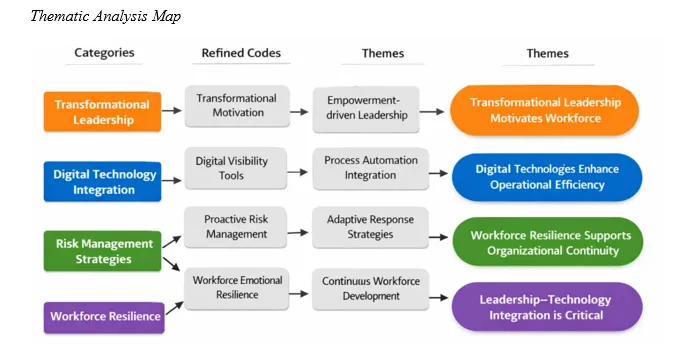
Note. Figure 1 shows a thematic analysis map for codes, categories, and themes.