
Student name
Capella University
MBA-FPX5910 MBA Capstone Experience
Professor Name
Submission Date
Capstone Presentation
Slide 1:
Hi! We are going to be discussing improving customer engagement and efficiency of Amazon through technology and data analytics in this presentation and my name is _________. We will be discussing how the business can be maximized through the use of technology and data analytics in the process.
Slide 2:
This project will attempt to enhance the efficiency of digital devices applied by the company to enhance customer experience and efficiency. The project will also assist the organization in enhancing its potential to apply predictive analytics to forecast future trends correctly in various areas, such as demand forecasting and inventory management. The organization will also be in a position to efficiently and effectively react to the needs of the customers in real time. Moreover, digital communication tools such as customer support application software and other digital communication tools need to be improved (Chaffey, 2023). It is necessary to keep the customer updated on all the changes in the process and offer individual services to the customer.
Slide 3:
Introduction to Amazon
The Amazon company is a technology/e-commerce company that is based in Seattle, Washington. The company is well-known due to its customer-orientedness, innovations, and technological prowess. Jeff Bezos started the company in the year 1994, and it began as an online bookstore; it is currently one of the top firms in the world (Yasar & Awati, 2025). Amazon is currently operating in various industries, which include online shopping, cloud computing, digital media services, and logistics. Amazon deals with a variety of goods and services, including normal household products to highly technical cloud-based products and services, via various platforms. Amazon is globally based with millions of consumers using technological and analysis software to provide efficient services (Yasar & Awati, 2025). Amazon has a number of employees who comprise engineers, logistics officers, and businessmen, among others.
Slide: 4
Problem Statement
The challenges that Amazon is going to experience when adjusting to the changing environment in the world of digital and technology are that, despite the company being ahead of the pack in terms of how it goes about its tasks including analyzing data and logistics operations, and even the avenue through which it communicates with its clients, some of these advanced systems have not been fully exploited by the company yet. It is also possible that there might be certain restrictions in the flow of information between various systems and departments, and this may lead to inefficiencies. And the last issue is that Amazon might face issues associated with how it deals with its consumers via digital means because of real-time and personalization issues.
Slide 5:
Project Objectives
- Within its current structure, the organization can leverage digital technology to optimize the effectiveness of its systems by improving the connection between different systems, such as the e-commerce platform, mobile application, and supply chain management systems. This will aid the prompt exchange of information to assist staff members in making decisions based on the correct information.
- Also, Amazon will be able to use predictive analysis to enhance its use of technology. By measuring the customer buying behaviour, Amazon will be able to accurately forecast the customer behaviour and operate its logistics operations and stocks.
- Moreover, Amazon has the opportunity to use the emerging technology in order to create consumer interaction. It will be necessary to improve the mobile application and communication systems to develop customer engagement and loyalty.
Slide 6:
Current State Analysis: Digital Tools
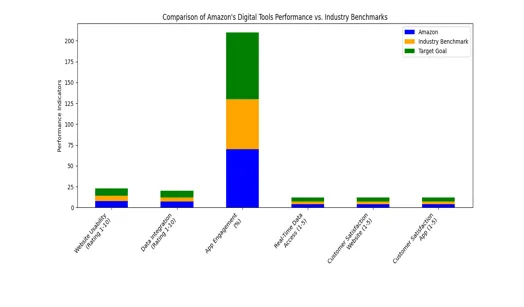
In fact, technology has immensely assisted Amazon in managing a vast amount of data pertaining to its business and customer needs. Another example of how technology has contributed to some of the changes in the industry is between Amazon and its customers (Yasar and Awati, 2025). Nevertheless, it is also possible to mention other problems, which should be taken into consideration when speaking about technologies that have been integrated into various processes, because of the disruption which it causes in the process of data communication (Zhong, 2025). This has created some level of inefficiencies and time wastage on the side of employees, particularly when it comes to dealing with information through the use of technology. In other instances, there has been no further development of different technologies to be integrated, and this has resulted in no personalization. These holes are depicted in Figure 01.
Figure 01
Comparison of Digital Tools Performance vs. Industry Benchmarks
Description of Data
- Website Usability (Rating 1-10): Amazon has an 8/10, higher than the industry average (6), and an objective (9) to increase the ease of navigating the webpage and user experience.
- Data Integration (Rating 1-10): Amazon has a rating of 7 out of 10 (a score of 7, compared to industry 5) in the area of data integration, with a target of 8, meaning that it is still improving towards complete interoperability of its digital systems.
- App Engagement (%): With an industry average of 60, customer engagement with Amazon apps is 70 out of a target of 80, indicating that it can implement more efforts to make the apps more interactive and engaging to customers.
- Real-Time Data Access (Rating 1-5): Amazon has 4 out of 5, which is higher than the industry average of 3, and a target of 5, which should further enhance the efficiency of timely decision-making and operations.
- Customer Satisfaction (Website, rating 1 to 5): online customers are asked to rate the level of satisfaction of the site at Amazon (so far, 4 out of 5), which is better than the industry average of 3, with an objective of 5 to maximize the online shopping experience.
- Customer Satisfaction (App, rating 1-5): Amazon has a score of 4 out of 5 on its mobile apps, which are rated as 3 in the industry, with the target of 5, an area of improvement to make the apps more usable and satisfying.
Slide 7:
Data-Driven Strategies for Operational Improvement
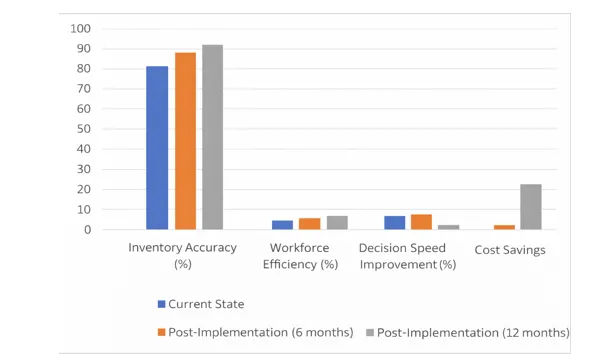
As observed in Figure 02 above, it is evident that Amazon uses the information it receives from its consumers to predict future occurrences and to operate effectively. This involves being aware of the trends and behaviour of their consumers and the analysis of their products’ demand in the market. Amazon will be able to make good decisions based on such information.
Figure 02
Projected Improvements in Operational Efficiency with Predictive Analytics
Benefits of Predictive Analytics
To illustrate this, in reference to Amazon, predictive analytics will be significant in understanding how much the customer needs in order to have the resources ready beforehand, i.e., how much they need in stock, how much in storage, and the labor they need to transport their goods. Predictive analytics will enable Amazon to plan into the future, and this implies that they will be able to provide expedited deliveries and customers will never be left behind since there will be no scarcity of items (Haque and Borbely, 2024). This will contribute to enhancing efficiency in business operations in the long term, even though the short-term will not entail any changes.
Slide 8:
Improving Customer Experience and Engagement
The usage of digital technologies, including order tracking, personalized recommendations, and account management, will help customers practice self-management at Amazon even more. Customers with mobile applications and websites find it easy to order, modify, and review their orders. Besides that, it has made the process of customers communicating with customer support easier, and they can now provide real-time feedback on their purchase (Haque & Borbely, 2024). By doing so, the customers will make improved decisions in making purchases. With the assistance of digital technologies, it can build relations with Amazon and obtain the trust and loyalty of the customers.
Slide 9:
Ethical Practices & Information Security
The ethical concern of the use of technology by Amazon is linked to the security of the personal information of customers. The firm has a responsibility to ensure that it implements measures and ensures that the data is not exploited in any way or another. This might not be easy indeed, as there is a tremendous amount of information about the customers. In spite of these, Amazon has put efforts into securing the data by encrypting the data, authenticating the data, and tracking the data regularly (Bao et al., 2022). This needs to be done by training the employees.
Slide 10:
Leadership Driving Technological Innovation at Amazon
The leadership with regard to innovative technologies at Amazon plays a vital role in its development. Technological innovation due to the leadership results in efficient processes in terms of efficiency, customer experience, and logistics. Leaders cannot be left out in terms of their role in encouraging collaborations through their motivational approach on how to inspire innovations to overcome the barriers to the use of technology (Hariyani et al., 2025). The team management in the framework of project management is reliant on IT expertise, analysts, and financial specialists to make an improved decision. Moreover, the teams also gather during cross-functional meetings, during which they exchange knowledge and address any concerns about the initiatives in accordance with the Amazon objectives.
Slide 11:
Recommendations
Some of the strategies that need to be implemented to enhance the efficiency of operation and involve customers in Amazon are given below. One of them would be to ensure that there is effective working of the firm’s software used to manage their data to allow the processes to run smoothly, as well as to make sure that the customers can easily access their product/services (Shivanand et al., 2023). The data analysis will be made predictive to be able to prevent and control the inventories and, therefore, minimize operating costs and make the supply chain more efficient. In addition, applications to the customers will be custom-made to involve the customers in the business.
Slide 12:
Expected Outcomes
The project aims to involve the customers to ensure that they are more efficient and cost-effective for Amazon. Using the right communication channels and digital communication channels, the team will be in a position to offer tailor-made services to its customers in a timely manner. In addition to this, Amazon will also be able to optimize itself, via demand estimation, resource allocation, and overseeing the supply chain process itself to guarantee goods arrive on time (Khedr & Sheeja, 2024). By doing so, efficiency will be achieved, as well as the optimal use of all the resources.
Slide 13:
Change Management Considerations
In order to achieve the desired outcomes of the digital transformation initiatives at Amazon, change management methods that involve not only communicating to all the stakeholders about the changes underway, but also scheduling training seminars for employees, need to be applied. By identifying the potential objections, the Amazon management will be able to counter the objections using their communication skills and provide support that will allow the employees to adjust to the changes. Biswas et al. (2026 )’s ideas on whether the digital transformation efforts will be successful or not are determined by the readiness of the employees to adopt new methods of doing things, since they are able to comprehend the need to undertake changes.
Slide 14:
Implementation Plan
The streamlining of the digital tools at Amazon will be done in a systematic, gradual process:
Phase 1: Evaluation of Existing Digital Tools.
- IT: Have a detailed analysis of the current digital platforms in order to know how the systems are integrated, how data flows, and the interaction between different departments.
- Operations Staff: Exchange knowledge and experience with existing tools on a daily basis on the workflow and discuss the areas that can be improved and where efficiency is lacking.
Phase 2: Predictive Analytics implementation (Months 34)
- Operations: Supervise the testing of predictive analytics to predict demand, optimize inventory, and allocate resources better.
- Finance: Measure cost reductions, efficiencies, and how predictive analytics affect the overall business performance.
The 3rd phase: Improvement of Customer-Facing Applications (Months 5-6)
- IT: Be the first person to integrate, update security, and enhance the functionality of the customer-facing apps of Amazon.
- Operations, Customer Service Teams: Try out the new features, get user feedback, and make the apps improve the interaction and customer experience.
Phase 4 System Evaluation and Improvement (Months 78)
- All Departments: Work together to test out the integrated system, fix bugs, and work out the workflows to be as efficient as possible.
- Such a gradual strategy will make sure that digital tools developed by Amazon are streamlined to the maximum, will facilitate the interaction of employees and customers, and will absorb quantifiable changes in the efficiency of operations, customer satisfaction, and business performance.
Slide 15:
Conclusion
With this approach, Amazon will enjoy the advancements that are going to be made in terms of technology, predictive analysis, and better customer applications. This will be achieved by assessing the current technology systems, rolling out predictive solutions to determine future requirements, and developing application systems that will keep the customers alive. This plan is oriented to guaranteeing the proper workflow and resource allocation management, which will make operations smoother. The company has also embraced good technology that has ensured that sensitive information in the operation process is safeguarded. Through these strategies, Amazon will be able to survive in the competition and be innovative.
References
Bao, Y., Li, W., Ye, Y., & Zhang, Q. (2022, March 26). Ethical Disputes of AI Surveillance: Case Study of Amazon. Www.atlantis-Press.com; Atlantis Press. https://doi.org/10.2991/aebmr.k.220307.220
Biswas, B., Rane, J., & Rane, N. L. (2026). Artificial intelligence for customer relationship management: Impact on customer experience, engagement, value creation, and loyalty. International Journal of Applied Resilience and Sustainability, 2(2), 503–536. https://doi.org/10.70593/deepsci.0202020
Chaffey, D. (2023). Amazon.com Marketing Strategy 2023: E-commerce Retail Giant Business Case Study. Smart Insights. https://www.smartinsights.com/digital-marketing-strategy/online-business-revenue-models/amazon-case-study/
Fenech, J., Richards, D., & Formosa, P. (2024). Ethical principles shaping values-based cybersecurity decision-making. Computers & Security, 140, 103795–103795. https://doi.org/10.1016/j.cose.2024.103795
Haque, D. M. E., & Borbely, Z. (2024). Examining the influence of digital transformation on consumer behavior: A study of Amazon’s e-commerce tactics in the retail sector. Welcome to the International Journal of Multidisciplinary Business Management, 12(4), 15–32. https://doi.org/10.56805/ijmbm.2024.12.4.102
Hariyani, D., Hariyani, P., & Mishra, S. (2025). The role of leadership in the sustainable digital transformation of the organization. Sustainable Futures, 10, 101130. https://doi.org/10.1016/j.sftr.2025.101130
Khedr, A. M., & Sheeja, R. S. (2024). Enhancing supply chain management with deep learning and machine learning techniques: A review. Journal of Open Innovation Technology Market and Complexity, 10(4), 100379–100379. Sciencedirect. https://www.sciencedirect.com/science/article/pii/S2199853124001732
Shivanand, R. G., Zhang, Z., Duan, J., & Liu, Y. (2023, December 11). Using Amazon as a case, a mixed-method study to explore the impact of Personalised Recommendation systems on User Experience and Decision-making. ResearchGate. https://doi.org/10.13140/RG.2.2.13685.96486
Yasar, K., & Awati, R. (2025, April 23). What is Amazon? TechTarget. https://www.techtarget.com/whatis/definition/Amazon
Zhong, Z. (2025). Analysis of Amazon’s business model. Advances in Economics Management and Political Sciences, 175(1), 52–58. https://doi.org/10.54254/2754-1169/2025.21952