MBA FPX 5006 Assessment 1
Student Name
Capella University
MBA-FPX5006 Business Strategy
Professor Name
Submission Date
Table of Contents
Assessment 1. 1
Executive Summary.. 3
The AFI Strategic Planning Framework.. 3
Internal Environment Analysis: VRIO Framework.. 4
External Environment Analysis. 5
Leadership Role in Strategic Planning and Ethical Responsibilities. 7
Strategic Recommendations for Leadership. 7
Conclusion.. 8
References. 10
Appendix A: VRIO Analysis for Starbucks. 12
Appendix B: PESTLE Analysis. 13
Appendix C: Porter’s Five Forces Analysis. 14
Executive Summary
This is a strategic analysis of the internal and external environments of Starbucks Corporation using the AFI framework, VRIO analysis, PESTLE analysis, and Porter’s five forces model. Regardless of the weaknesses in its performance that Starbucks has been experiencing in the recent past, the company has managed to maintain a competitive advantage in its operations, mainly as a result of its global brand, supply chain management, and human resources. The external analysis reveals that the competition is stiff, the buyers’ power and the great environmental forces are in need of strategic change and innovation. The threats and opportunities brought about by PESTLE forces like economic instability, society towards sustainability, and technological disruptivity are threats as well as opportunities.
The executive led by CEO Brian Niccol has embarked on the Back to Starbucks program of restoring the coffeehouse experience and operational excellence. The ethical leadership roles include the fact that one needs to be in a position to practice integrity, accountability, fairness, and social responsibility in their acts during strategic planning and implementation. Among the recommendations that can be made to help to improve the situation are making menu offerings simpler, improving store environments, investing in employee development, and maximizing digital engagement platforms. These strategy plans will place Starbucks at the forefront of regaining a competitive advantage, re-establishing customer loyalty, and achieving long-term sustainable growth.
The AFI Strategic Planning Framework
The strategic frameworks can provide systematic structuring of the business planning and competitiveness in modern business environments. AFI is comprised of three tasks, which are interdependent and provide a competitive advantage: analyze, formulate, and implement (Anderson et al., 2025). The analysis of the internal potential and the external environment is conducted, the strategic responses are developed, and changes within the organization are provided in a highly developed manner. This level of systematic approach would enable the managers to handle the complexity whilst seeking to attain sustainable organization performance as well as leadership in the market.
In the modern competitive business world, where businesses operate on a global scale, businesses require a well-coordinated approach to this so that they maintain a competitive edge in their competitive environment. The strategic planning frameworks allow the social resources of the organizations to be oriented in a more efficient way towards the environmental opportunities that augment the degree of certainty and effectiveness in decision making (Pitelis et al., 2023). These structures assist in alignment of the organization, and all the departments tend to pull towards one direction of respective common strategic goals and objectives in the long run. Subsequently, it renders the systematic strategic approaches relatively basic to organizations that desire to achieve long-term success and a competitive edge.
Internal Environment Analysis: VRIO Framework
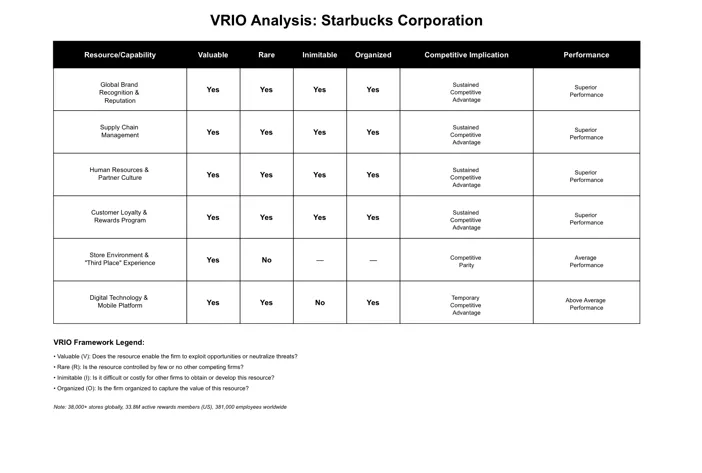
These internal resources and capabilities enable organizations to determine the competitive positioning at any given time in the ever-competitive markets. There are four significant sustained competitive advantages of Starbucks that have been analyzed using VRIO analysis: The global presence, brand reputation, supply chain management, and human resources capabilities. The company brand name, in its part, offers absolutely invaluable and rare quality and continuity accolades of coffee markets across the globe (VanZandt, 2023). The supply chain management and human resource practices embraced by Starbucks can hardly be replicated to create sustainable competitive advantages amid other businesses. All these core competencies enable Starbucks to charge high prices, yet have high customer loyalty in all its international business operations.
Using its internal capabilities effectively to execute its differentiation strategy of high quality and customer experience has enabled Starbucks to effectively implement its differentiation strategy. The company relies on its network of over 38,000 stores all over the globe to stay abreast with the advantages in the market and the magnitude of operation (Punzalan, 2025). Starbucks is using this great culture, and its partner focus strategy in an attempt to offer high quality and consistency of experience in all its outlets across the world. However, such a range of decreased comparable store sales in Q4 2024 indicates that there are issues with the implementation in recent times (Starbucks Corporation, 2024). The organization needs to go a step further and make its operations efficient, and yet still maintain its strengths, so that they ensure that it will remain efficient in its operations in the long run.
Starbucks has an organizational structure that is a matrix that comprises functions, geographic, and product-based divisions to enable it to effectively support its operations across the world. The regional adaptation to the local market interests and conditions can become possible owing to this type of organization that can facilitate cross-functional cooperation and innovations, and certain preconditions (Meyer, 2025). Centralization of decision-making at the headquarters ensures uniformity in the brands, but may lead to the company lagging in adapting to the rapidly changing market dynamics in the local market. Though complexities in the operation of a matrix structure are inevitable, the organizational design of Starbucks facilitates the alignment of organizational strategy and helps to differentiate in competition. A decent organizational structure will still be relevant as far as achieving the long-term strategic goals and competitive advantages in the global market is concerned.
External Environment Analysis
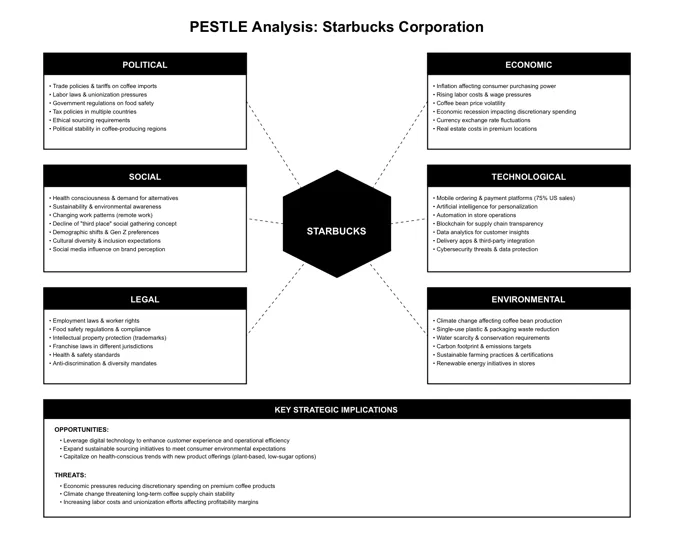
The dynamic world of business is very competitive, and external environmental factors have a big influence on the organizational strategy formulation and its ability to take a competitive advantage. Such critical challenges that Starbucks is grappling with, such as the political pressure on the ethical sourcing and economic volatility on consumer purchasing power in the global market, are identified by the PESTLE analysis (Carter et al., 2022). The trends of the society, the demand for health-conscious and sustainability requires significant adjustments in an organization and strategic adjustments of the coffee retailer. The opportunity comes in the form of mobile ordering solutions and threats like the availability of home-brewing, to the coffeehouse experience (Panmore, 2024). Even the problems of legal compliance requirement/environmental sustainability requirements also threaten to make the functioning of Starbucks in its different international markets even more complex. Being aware of these macro-environmental factors, organizations can develop effective strategies on how to achieve a strong competitive advantage and long-term growth strategies.
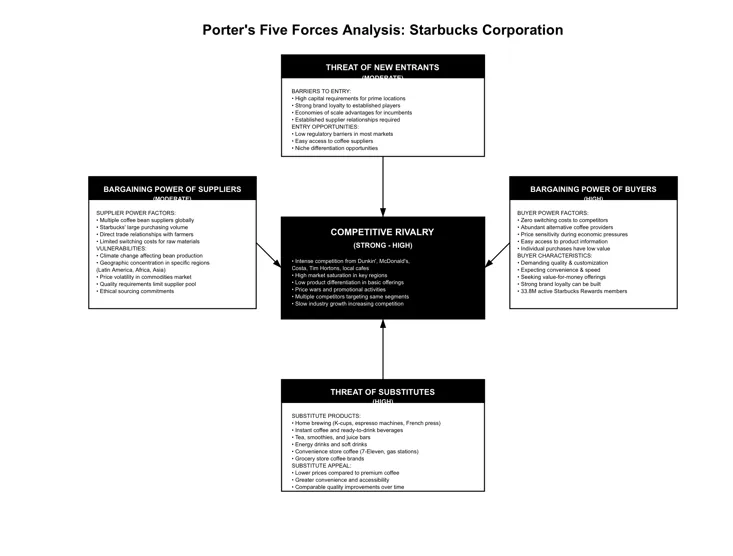
There is a particularly great competitive rivalry, buyer power, and threat of substitutes in the case of Starbucks, as can be noted using the Five Forces analysis developed by Porter. The level of the competitive rivalry can be defined as high due to the fact that there are numerous international chains like Dunkin’, McCafé, McDonald’s, and thousands of other local coffeehouses. The bargaining power of buyers is high as the customers have a zero switching cost, and also due to the presence of many alternative suppliers in the market. The threat of substitution is high in the case of home-brewing machines, instant coffee, and other beverages, as they have ready-to-use substitutes (Greenspan, 2025). The supplier’s bargaining power is average since Starbucks has good purchasing power, as a result of its high levels of both global buying volumes and diversification. All these competitive forces affect the strategic priorities and would necessitate uncompromising innovation to be the market leader and profitable.
To enhance its competitive advantage, Starbucks should enhance brand differentiation, expand its digital presence, and increase resilience in its supply chain. To capture the market and hold firmly against the aspect of substitutes through superior experiences, the firm needs to embark on aggressive marketing. Distributing power by diversifying supplier relations in a multi-geographic area will contribute to reducing fluctuations in prices as well as ensuring the consistency of the quality of coffee supply (Wang et al., 2023). Reducing buyer power can be achieved through investing in developing technological innovations and establishing a personalized experience with the customers with the help of mobile platforms, and increasing the loyalty rate. By showing corporate social responsibility and premier positioning in the markets, the issue of environmental impacts and the changing consumer values in the markets would be resolved (Nardi, 2022). Still paramount in ensuring competitive advantages in the ever-challenging global markets is the ability of strategic responses to such external forces.
Leadership Role in Strategic Planning and Ethical Responsibilities
Leadership plays a very critical role in reflecting the organizational vision, making stakeholders as well as the initiatives of the strategic change. Strategic leaders recognize purpose at the organizational level, develop human capital and effective cultures that are long-term and sustainable to provide a long-term competitive advantage. The leaders ought to instill such a culture whereby the employees can be able to think and make proactive contributions towards the organizational goals and strategic planning processes. Ethical leadership also ensures that the decisions made are equitable, transparent, and accountable without losing the trust of the stakeholders and organizational members (Dahiya et al., 2025). The strategic leaders’ approach towards planning will be that the risks and the safeguards will be established according to the ethical issues established during the strategic planning process.
Big ethical jobs that leaders perform are upholding integrity, acting according to the values of the organization, and having clear communication. The accountability ensures leaders own the decisions, commit errors, and have clear performance expectations for the teams. Fairness involves fairly treating all the stakeholders and an inclusivity and justice during the process of distributing the available resources, as well as decision-making. Social responsibility stimulates leaders to consider the impact on society, embrace sustainability, and become corporate citizens, besides being profitable (Amir et al., 2022). These ethics assist leaders in building trust, reputation, and cultures of responsibility needed to achieve a long-term competitive advantage and organizational excellence in dynamic business environments. In this way, ethical leadership becomes not merely a guiding principle but a strategic asset that sustains organizational integrity over time.
Strategic Recommendations for Leadership
Firms with a rotting performance require all-round strategic interventions that are both performance and identity-based. The Starbucks management should be preoccupied with the Back to Starbucks plan that would strive to re-create the coffeehouse experience as a third place (Niccol, 2024). The company needs to enhance the overcomplicated menu by making it simpler and enhancing the efficiency of the operations to attain four minutes of service delivery at any given time (Lucas, 2024). The leadership should make huge investments in staff development, increase the number of staff, and promote ninety percent of retail leaders within the organization. These strategic plans will require the leaders to create a balance between technological innovation and bona fide human interaction and community building in coffee house settings.
Starbucks should embellish the store design by reinstating the problem of comfortable seating, bars, and ceramic mugs of condiments that will keep the customers lingering. The marketing should be geared towards quality coffee at newly enhanced levels and to larger audiences, not just to the existing Starbucks Rewards membership base. The leadership will maximize the mobile ordering systems so that they minimize the number of people congesting the stores without affecting personal interactions with baristas, as well as the quality of services provided to customers. Redesign, such as non-performing unit dropping, will free up funds to utilize on technology and training as well as improvement of customer experience (Meyersohn, 2025). These recommendations can be applied in a systemic way such that Starbucks will be capable of not only holding on to its competitive edge, but also regaining the brand loyalty to the company, not to mention enjoying sustainable growth.
Conclusion
Starbucks is an enterprise that has a few major strategic challenges that require a lot of organizational change and a new focus on core brand differentiation and values. The proposed plans, which will see the company concentrate on its own strengths, competition forces outside, and cultural regeneration, will determine how successful it will be in the future. The issues of ethical practices, employee empowerment, and customer-centered innovation are quite crucial in leadership and externalities that are relevant to competitive advantage in markets. This underscores the extent to which internal culture and external market forces are closely intertwined. By leveraging the strong points of an organization and reducing the selected sources of weaknesses, as well as external threats, Starbucks will be able to successfully address the existing challenges. The turnaround plan will involve a smooth execution of the plan, and the company cannot afford to lose brand integrity and trust of its stakeholders.
References
Amir, M., Siddique, M., & Ali, K. (2022). Responsible leadership and business sustainability: Exploring the role of corporate social responsibility and managerial discretion. Business and Society Review, 127(3). https://doi.org/10.1111/basr.12284
Anderson, L., Buengel, D., & Simpson, J. J. (2025, August 20). 1. Introduction to strategic management. Strategic Management and Case Analysis: An Integrated Approach; Virginia Tech Publishing. https://pressbooks.lib.vt.edu/strategicmanagementandcaseanalysis/chapter/introduction-to-strategic-management/
Carter, D. B., Warren, R., & Steinhoff, A. (2022). The anatomy of tragedy: Starbucks as a politics of displacement. Accounting, Auditing & Accountability Journal, 36(1). https://doi.org/10.1108/aaaj-08-2015-2169
Dahiya, R., Selvakumar, P., Ahluwalia, G. K., Sujata, Manjunath, T. C., & Anute, N. (2025). Ethical leadership and decision making. Advances in Ethical Work Climate and Employee Well-Being, 45–66. https://doi.org/10.4018/979-8-3693-8819-8.ch003
Greenspan, R. (2025, October 23). Starbucks five forces analysis & recommendations (Porter’s model). Panmore Institute. https://panmore.com/starbucks-coffee-five-forces-analysis-porters-model#google_vignette
Lucas, A. (2024, October 31). 7 ways that Starbucks CEO Brian Niccol plans to change the coffee chain. CNBC. https://www.cnbc.com/2024/10/31/starbucks-ceo-brian-niccol-change.html
Meyer, P. (2025, October 24). Starbucks Coffee’s organizational structure & its characteristics. Panmore Institute. https://panmore.com/starbucks-coffee-company-organizational-structure
Meyersohn, N. (2025, December 31). Starbucks doesn’t want to be on every street in New York and Los Angeles anymore. CNN. https://edition.cnn.com/2025/12/29/business/starbucks-coffee-new-york-los-angeles
Nardi, L. (2022). The corporate social responsibility price premium is an enabler of substantive CSR. Academy of Management Review, 47(2). https://doi.org/10.5465/amr.2019.0425
Niccol, B. (2024, September 10). Message from Brian: Back to Starbucks. About Starbucks. https://about.starbucks.com/press/2024/back-to-starbucks/
Pitelis, C. N., Teece, D. J., & Yang, H. (2023). Dynamic capabilities and MNE global strategy: A systematic literature review‐based novel conceptual framework. Journal of Management Studies, 61(7), 3295-3326. https://doi.org/10.1111/joms.13021
Punzalan, C. A. (2025, July 11). How Starbucks market dominance strategy conquered the global coffee industry | AMW. Amworldgroup.com. https://amworldgroup.com/blog/starbucks-market-dominance-strategy
Starbucks Corporation. (2024, October 30). Starbucks reports Q4 and full fiscal year 2024 results. Starbucks Investor Relations. https://investor.starbucks.com/news/financial-releases/news-details/2024/Starbucks-Reports-Q4-and-Full-Fiscal-Year-2024-Results/
VanZandt, P. (2023, July 24). VRIO framework example: A practical breakdown of Starbucks. IdeaScale. https://ideascale.com/blog/vrio-framework-example-a-practical-breakdown-of-starbucks/
Wang, Q., Zhou, H., & Zhao, X. (2023). The role of supply chain diversification in mitigating the negative effects of supply chain disruptions in COVID-19. International Journal of Operations & Production Management, 44(1), 99–132. https://doi.org/10.1108/ijopm-09-2022-0567
Appendix for
MBA FPX 5006 Assessment 1
Appendix A: VRIO Analysis for Starbucks
 Appendix B: PESTLE Analysis
 Appendix C: Porter’s Five Forces Analysis