

Student Name
Capella University
DB-FPX8620 High Performance Leadership
Professor Name
Submission Date
Introduction
The adoption of artificial intelligence (AI) in financial services remains booming at an accelerated rate, with its use extending to risk assessment, fraud detection, customer analytics, and workforce optimization. Worldwide investment in AI in the financial services industry, such as banking and insurance, is set to grow to about 97 billion dollars by 2027, with AI-powered automation in the process of increasingly improving operational efficiency; some institutions are reporting cost savings of an average of 45 percent across automated processes (Vukovic et al., 2025). The growing dependence on AI-based mechanisms promotes the requirement of a powerful executive management that could overcome regulatory requirements, ethical issues, and organizational problems that relate to the implementation of algorithmic decision-making systems (Cajueiro and Celestino, 2025). The modern literature focuses on leadership frameworks founded on the combination of governance schemata with innovation-based approaches to deal with AI in a responsible manner that does not have detrimental effects on facilitating competition development. The given research is focused on detecting leadership practices that allow effective human-AI cooperation in the context of digital transformation. An effective AI leadership framework is entailed in long-term financial growth and strategic sustainability.
Problem of Practice
The overall issue is that AI-enhanced finance services are becoming more complicated and thus require the creation of new leadership structures that can regulate the sophisticated digital services without affecting performance at the strategic level. Numerous financial institutions are still increasing AI use in risk management, fraud detection, and credit rating, but leadership skills do not keep up with the fast development of AI systems. It has been demonstrated that the lack of executive supervision is one of the factors that increase the risk of algorithmic bias, cybersecurity risks, and subpar adherence to regulations (Cremer et al., 2022; Konopik et al., 2021).
Consequently, the integration of AI into an organization is dangerous in the absence of a strategic orientation based on excellent leadership practices. The identified issue is the lack of a clear leadership strategy that can facilitate efficient human and AI cooperation in the case of the digital transformation of the financial sector. Researchers have indicated that numerous financial organizations are overly dependent on automation without having governance systems to mitigate analytical solutions, together with ethical controls and human discretion (Aslam et al., 2025). Teams of leaders tend to use AI tools to make operations more efficient, but the organization is not adjusted to them, and the employees cannot use AI-generated information responsibly. The absence of formal leadership paradigms increases the issues regarding the credibility of AI, the responsibility of stakeholders, and the openness of decisions.
Problem Manifesting
The issue is being reflected in the inconsistent practices of adopting AI, inequality in preparing the workforce, and the decrease in confidence in the decisions supported by AI. A significant number of financial organizations report that their employees are resistant, they lack technical competency, and direction on how human roles are supposed to change in tandem with the development of algorithmic systems (Koo et al., 2025). The challenges that arise in operations, in cases where frontline managers do not have the knowledge on how to interpret AI outputs or apply AI-generated insights in strategic planning. Lack of a coherent structure of leadership undermines the worth of AI investments and fosters tension in the company, which leads to performance gaps, ethical ambiguity, and untapped abilities of digitalization.
Gap in Practice
The practice gap lies in the absence of an organized leadership framework facilitating human-AI cooperation in the process of digital transformation of the financial sector. Even today, most financial institutions are still growing in the use of AI in risk analytics, fraud detection, and customer modeling, but organizational leaders often operate without advice that accounts for the governance, ethics, and development of the workforce (Goyal et al., 2025). Existing leadership perspectives place much emphasis on automation benefits and ignore the fact that models that would place AI as an ally to human professionals are necessary (Mikalef and Gupta, 2021; Przegalinska et al., 2024). Due to this, organizational leaders have a hard time balancing AI capabilities and strategic priorities, which results in a lack of consistency in oversight and lower-quality decision-making.
There is a substantial gap between the present positions, where AI is implemented in a disjointed manner, employees are unprepared, and the system of governance is not clearly defined, and a desired one, where the system of leadership is in place in a manner that encourages responsible implementation of AI, constant up-skilling, and open decision-making. It was found that the capacity to achieve adaptability, better risk management, and enhanced trust in AI-generated information is seen in organizations that have a formal human and AI collaboration structure (Koo et al., 2025; AlNuaimi et al., 2022). This absence is the gap in practice because financial institutions are struggling with performance issues that were based on the lack of leadership guidance, role ambiguity, and light support of collaborative intelligence. The identified gap requires a comprehensive leadership model that would guarantee sustainable value in AI-enabled transformation.
Purpose of the Project and Project Questions
The intended aim of the proposed qualitative business project is to review leadership practices that can promote successful human and AI partnerships in financial services organizations. The research paper will employ a case study project methodology to examine the way managers build governance frameworks, develop ethical norms, and apply workforce development policies that enhance AI-enhanced change. Increasing dependence on sophisticated analytics, automation, and predictive analytics has posed new challenges for leadership styles that are both innovative and responsible. The use of AI tools by many financial institutions has not yet developed a coherent leadership model that can combine organizational culture, the capacity of employees, and open decision-making (Shaban & Omoush, 2025). The search on the actions of leaders, communication patterns, and the presence of structural aids will help to better understand how executives can manage regulatory expectations, reduce the risks of algorithms, and create trust in AI-driven insights. The knowledge that is produced out of the study will inform the development of a leadership framework that will enable the sustainability of competitive performance in a process of continuous digital evolution.
Project Questions
- What organizational practices allow leaders in the financial sector to facilitate successful human-AI cooperation in the digital transformation?
- Which leadership practices can be used to govern responsible AI, staff preparation, and ethical decision-making within financial services organizations?
Preliminary Terms and Definitions
Human–AI Collaboration
Human and AI collaboration is a format of collaboration, whereby artificial intelligence systems and human professionals bring their respective areas of strength to bear in the decision-making process within the organization. The AI offers the ability to process information faster, with an analytical interior and identifying patterns, whereas human participants provide the framework for reasoning, morality, and strategic insights (Papagiannidis et al., 2025). The idea focuses on symbiotic engagement, as opposed to the automation-based substitution, and becomes a cornerstone of leadership activities that embrace the responsible digital change.
AI Governance
The AI governance entails the organizational policy, control systems, and ethics that govern the design, implementation, and continued use of artificial intelligence tools. The practices of governance create responsibility of fairness of algorithms, data security, regulation, and accountability of automated processes. Well-developed governance structures can lead leaders to handle the risks of predictive analytics and machine-learning applications in the financial services sector (Papagiannidis et al., 2025).
Digital Transformation Leadership
Digital transformation leadership is a collection of executive actions, strategic capabilities, and organizational processes that will facilitate the successful implementation of sophisticated technologies. Leaders who work in the context of AI-enabled processes have to combine innovation management, ethical responsibility, and development of the workforce to ensure sustainable technological progress. The concept brings to the fore the role of leadership in aligning the organizational culture, technical capabilities, and long-term digital strategy (Sacavem et al., 2025).
Project Justification
The rapid implementation of financial services into artificial intelligence has prompted a rapid need to develop leadership models that will allow proper human and AI cooperation. Research has suggested that, in the absence of organized governance, ethical protection, and workforce building, AI projects will lead to biased results and inefficiency in operations and reduced trust among stakeholders (Mikalef and Gupta, 2021; Przegalinska et al., 2024). Literary sources also highlighted that executives usually have difficulty trying to incorporate AI in strategic planning and ensuring regulatory compliance and organizational accountability (Svejvig, 2021). The observations show that there is a strong necessity to research leadership strategies that will allow for integrating AI sustainably and responsibly. The proposed project questions are critical to answer since existing literature reveals disjointed strategies of adoption of AI, but it provides little information on leadership practices that are both innovative and people-centered.
The knowledge gap can be addressed with the insights obtained through the case study of governance, workforce readiness, and ethical decision-making that can be used to offer evidence-based frameworks for those who want to make the most of AI value and reduce the risks associated with it (AlNuaimi et al., 2022; Koo et al., 2025). The knowledge of the mentioned strategies helps to make digital transformation initiatives more efficient. The project is significant to organizational leaders and executives, as well as innovation managers within financial institutions who want to implement AI in a responsible and strategic way. The research results will help decision-makers to structure governance, understand employee skills, and create confidence in AI-enhanced processes. This will positively affect the stakeholders, such as the regulators, customers, and employees, who will see a difference in that there will be better leadership practices, which will make the operations more transparent, ethical, and robust. Finally, financial organizations can use the project outcome to attain a sustainable competitive advantage within an environment that is becoming highly technological.
Author Note: Reflection on Alignment
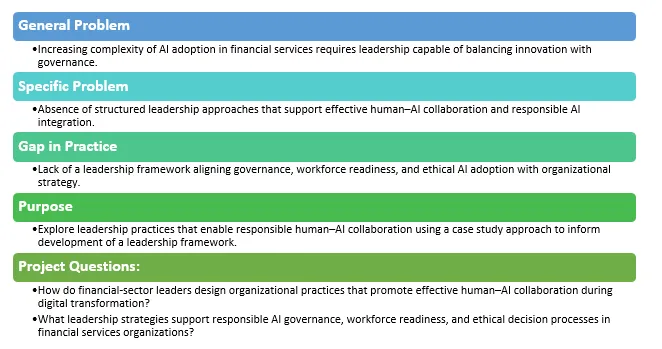
The correspondence between the general problem, specific problem, gap identified, purpose, and project questions proves a consistent focus on effective leadership practices, which make it possible to collaborate effectively with humans and AI in financial services. The general issue illustrates the complexity of adopting AI and the need to have a strategic leadership approach, whereas the specific issue illustrates the lack of systematic ways of leadership to steer ethical, accountable, and effective AI implementation. This practice gap highlights the difference between the existing disjointed leadership practices and what a human-AI partnership is supposed to be in a state of complete, comprehensive, and governance-based collaboration. The purpose statement and the project questions also directly respond to the gap identified by discussing the leadership strategies, governance frameworks, and workforce development programs that are needed to improve AI-enabled transformation. Uniformity among all aspects would guarantee that the proposed research is consistent to formulate practical conclusions to leaders who want to balance technological advancement with business responsibility, ethical practices, and sustainable competitive advantage.
Figure 1
Graphical Representation
Preliminary Project Frameworks
A framework is a theoretical structure that coordinates assumptions, relationships, and principles of a scholarly inquiry. A strong framework allows the organization and support of a project with the help of establishing analytical limits, formulation of necessary constructs, and specifying the manner in which a phenomenon is to be studied. A carefully selected framework enhances consistency in all project aspects, guiding the alignment of the problem of practice, the identified gap, the purpose, and the proposed inquiry route. A framework is also more conceptually rigorous as it provides a base on which data interpretation is anchored and informs methodological choices applicable in terms of leading digital transformation in the financial services (Svejvig, 2021). A framework directs the collection of data by informing the researchers on the constructs they should explore, the relationships they should investigate, and the organizational behaviors they should observe in detail. To make sure that the leadership behaviors, the governance structures, and patterns of human-AI collaboration are examined in detail and in a systematic manner, alignment within a framework, qualitative case study technique, and project questions are ensured.
Sociotechnical Systems (STS) Framework
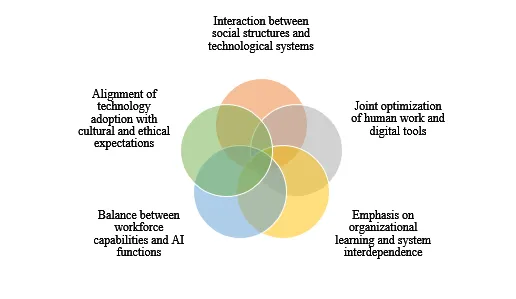
The sociotechnical systems approach focuses on the mutual optimization of social systems and technological systems. The main concepts are those of work redesign, human-technology interaction, organizational learning, and systemic interdependence. The use of STS lens underpins the argument of the necessity of approaches to leadership that incorporate balanced analytical skills and human judgment, as highlighted in the previous studies that found exposure to algorithmic bias, skewed workforce preparedness, and inconsistent governance (Cremer et al., 2022; Koo et al., 2025). STS orientation is directly aligned with the problems of the financial sector, in which digital decision engines need to be merged with the capabilities of employees, ethical concerns, and cultural demands. The alignment with the project is supported by the fact that the framework has a concentration on the coordinated interaction between human expertise and AI systems, in support of the fact that the current study focuses on collaborative intelligence, and the fact that the automation does not serve as the source of displacement. Deductive application of STS can be used to investigate structural patterns that can influence the successful implementation of AI, and inductive reasoning can be used to uncover emergent leadership practices based on the conditions of the real world.
Figure 2
Sociotechnical Systems Framework
Responsible AI Governance Framework
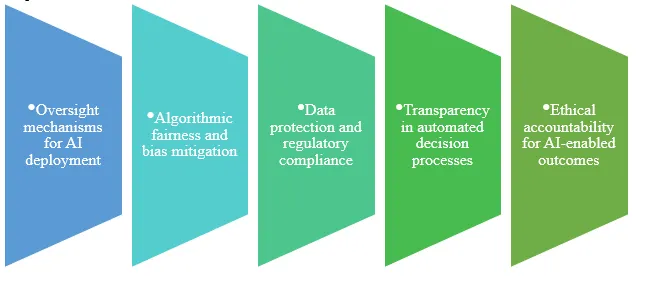
An ethical and responsible AI governance model focuses on accountability, regulatory compliance, ethical design, and transparency. These are concepts such as oversight mechanisms, algorithmic fairness, risk management, and data stewardship (Papagiannidis et al., 2025). Effective models of governance can deal with the issues identified in the literature about unstable executive control, inadequate regulatory alignment, and lack of ethical direction in the implementation of AI (Goyal et al., 2025). The aspect of a responsible AI governance lens is consistent with the objective of the project to comprehend the strategies of leadership that guarantee the preservation of trust in the stakeholders and maintenance of transparent decision-making processes. The deductive application can be used to compare the leadership actions with the already developed standards of AI ethics. Inductive analysis aids the identification of setting-specific governance innovations that are emerging among financial institutions that are involved in digital transformations.
Figure 3
Responsible AI Governance
Digital Transformation Leadership (DTL) Framework
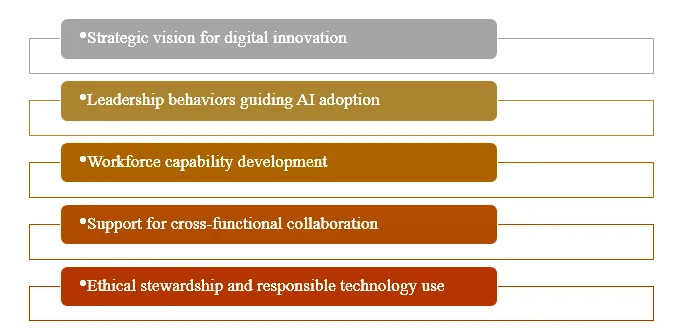
An online transformation leadership framework identifies visionary strategy, innovation coordination, culture building, workforce competency development, and focusing digital initiatives on long-term organizational goals (Sacavem et al., 2025). Key principles focus on the leader’s task to cultivate digital attitudes, facilitate cross-functional interdependence, and manage the adoption of modern technologies like predictive analytics and automation. The reporting of literature broken down leadership practices, role ambiguity, and poor workforce preparation in financial institutions highlighted the necessity of a leadership framework that would help in steering strategic AI adoption (Aslam et al., 2025; Koo et al., 2025). The correspondence to the project is due to the fact that the framework is directly concerned with such aspects of leadership as behaviors and organizational systems that facilitate human-AI collaboration. Deductive reasoning aids in direct testing of leadership behaviors against the competencies presented in DTL theory, whereas inductive reasoning aids in elaboration of any new leadership trends that have been brought about by findings of the case.
Figure 4
Digital Transformation Leadership Framework
Framework Best Aligned With the Proposed Project
The DTL framework is the one that offers the best conceptual fit to the proposed project compared to the other two assessed frameworks. A leadership-based framework is a direct response to the determined gap in the practice, as it revolves around the lack of holistic solutions to promote collaborative intelligence when transforming financial services through AI-facilitated change. Researchers have stressed the role of leadership capability as a central factor of ethical, strategic, and operational performance at the advanced analytics implementation (Mikalef, 2021; Gupta et al., 2021). A DTL foundation is also well-suited to be used with a qualitative case study approach, as it informs the creation of interview guides, organization document review approaches, and analytical tools to be applied in interpreting leadership behaviours, communication patterns, and structural decisions. The studies of the leadership strategies in the digital age emphasized such aspects of leadership that required strategic vision, moral responsibility, and the development of the workforce when leading the integration of AI (Sacavem et al., 2025; Shaban and Omoush, 2025). The alignment of the DTL framework with those competencies makes it a strong analytical landmark to study the leadership practices and strengthen human-AI collaboration and increase organizational resilience in the face of digital transformation in the financial sector.
Preliminary Project Plan
Technique 1: Qualitative Inquiry Technique
Qualitative enquiry presents the best in-depth information regarding practices that leaders use to face challenges associated with the use of AI applications in the context of financial institutions. The three qualitative research methods, which include semi-structured interviews, focus groups, and thematic analysis, enable the researcher to bring out a detailed investigation. According to the existing qualitative data, the research under consideration explores the changes in leadership concerning the aspect of digital transformation through the study of strategic preparedness and leadership preparation (Torres et al., 2025). The researcher was planning to find participants in the leadership groups to experience information about AI applications, labour changes, and decision-making styles (Mennella et al., 2024). The approach aims at addressing the current gaps in practice by exposing practice-proven leadership approaches and constraints found in the contemporary scholarly literature. A qualitative approach will be necessary in the project because the exploratory research will require gaining knowledge through direct interaction with the leaders who practise artificial intelligence in their work. The data collection and analysis will be thematic and will be based on the predetermined questions of the project. The integration of the transformational leadership theory allows one to comprehend the way leaders act and their influence on the organization. The qualitative coding in the project is used to reveal the hidden patterns and repetitive themes in an inductive research design. Thematic analysis is useful to identify patterns and insights because qualitative interviews based on the transformational theory of leadership effectively disclose the processes of decision-making and organizational impact by the leaders (Torres et al., 2025). The methodology leads to flexibility of the research, which generates a high level of contextualization of actual, professional experiences in the industry.
Technique 2: Quantitative Regression Technique
A qualitative inquiry method provides a systematized method of investigating leadership practices that inform human-AI collaboration in the financial services industry. A qualitative case study method facilitates inquiry into managerial attitudes, government activities, patterns of communication, and strategies of planning the workforce. A case study method also allows for a closer look at the real-life settings in which advanced analytics, automation, and predictive modeling are at work and in the day-to-day operations. Comprehensive descriptive information collected during interviews, internal sources, and observation makes it possible to gain a profound insight into responsible AI integration-specific behaviors of leadership (Skouloudis and Venkatraman, 2025). This direction is in line with the project purpose, which concentrates on the definition of practices that optimize human-AI interaction, and contributes to exploring conceptual spheres suggested in the digital transformation leadership framework. A qualitative case study plan is sufficient to solve the issue of insufficient leadership capacities in AI-powered financial spaces by involving managers with a direct impact on governance, ethical controls, and the preparedness of the workforce. The triangulation would be facilitated by various sources of data in the analysis, which would increase credibility and offer a multidimensional perspective of the impact of leadership dynamics on the adoption of AI (Skouloudis and Venkatraman, 2025). Coding processes would be aimed at the establishment of themes of strategic vision, ethical alignment, transparency in decision-making, and the development of employees ‘ capabilities. The knowledge obtained through the qualitative plan would lead to changes in the identified gap in practice directly, as it would expose the leadership strategies that enhance collaborative intelligence in the process of digital transformation.
Author Note: Reflection on Organizational Agendas
Another method that can be used to analyze the correlation between the leadership variables and the result of human-AI collaboration is a quantitative regression technique. The regression model may be used to measure how leadership variables, including digital readiness, governance strength, cross-functional coordination, ethical climate, etc., affect measurable outcomes, including the effectiveness of AI adoption, employee trust in AI-supported decisions, or workforce capability development (Torres et al., 2025). Data may be gathered by assessing validated survey tools that will be provided to employees and managers in the financial sector, and statistical analysis of predictive relationships among the constructs of leadership and the performance of digital transformation. The regression approach would involve adjusting the project question to make it conform to a quantitative orientation. One of the appropriate questions might be the following: How far can leadership practices that are associated with digital transformation be used to predict the efficacy of human-AI partnership in financial services organizations? An updated purpose statement would also focus on measurements and statistical tests as opposed to exploratory knowledge. A quantitative research plan would bolster the generalizability and assist in the construction of an evidence-based appraisal of particular leadership competencies that affect AI-based results in a bigger cohort (Svejvig, 2021). Nevertheless, such a strategy would divert attention to other things in contextual information derived from a qualitative inquiry.
Author Note
The objective of the project is aimed at comprehending the practices in leadership that enhance cooperation between human professionals and AI systems in the sphere of financial services. The focus on ethical control, responsible use of technology, and workforce preparation is also similar in many organizations that operate in the field of digital transformation. Professional organizations like the Association of Information Systems, digital transformation research network, and international institute of Analytics transcend leadership capacity as an ingredient that encourages safe and strategic application of advanced technologies. Funding and research centers assist in enhancing better governance mechanisms, open decision-making, and lifelong learning among staff members who engage with AI tools (Yu et al., 2023).
The mission of the project is in line with the priorities as it aims at finding leadership practices that can mitigate risks, promote trust, and foster organizational performance in the digital evolution. The matters of responsible AI leadership are also sponsored by grant providers and policy-oriented organizations. Organizations like the National Science Foundation illustrate the issues related to fairness, accountability, workforce skills, and the organization being ready to implement AI (Mennella et al., 2024). The aim of the project is consistent with the agendas as it is focused on the ethical standards, human judgment, and the leadership strategies that will be used to achieve a successful cooperation between AI systems and human professionals. The project further supports greater objectives in digital transformation studies in the form of an insight into leadership practices that facilitate organizational resilience, visible leadership, and sustainable innovation.